|
|
 |
| |
| H I S T O R Y |
Timeline of Iranian Art & History
Metropolitan Museum of Art, New York, 8000 BC – 21st Century |
by: Massoume Price
Last Updated: |
| Page 3 of 6 |
 |
224–626 A.D.1256–1353

Frieze tile with phoenix
ca. 1270s,
Iran (probably Takht-i Sulayman)
Fritware, overglaze luster-painted |
The Ilkhanids, the branch of the Mongol dynasty that takes control of West Asia after putting a definitive end to the cAbbasid caliphate (1258), establish rule from the city of Tabriz in northwestern Iran. Following the Ilkhanid sultan Ghazan's conversion to Islam in 1295, both religious and secular arts flourish. East Asian elements absorbed into the existing Perso-Islamic repertoire create a new artistic vocabulary, one that is emulated from Anatolia to India, profoundly affecting Islamic art. In this regard, the arts of the book, especially illustration, are particularly significant. The widespread use of paper enables the transfer of designs from one medium to another. |
ca. 1275–1350

Isfandiyar's Funeral Procession: From the
Great Mongol Shahnama (Book of Kings)
1330s,
probably Tabriz, Ink, colors, and gold on paper |
Along with their renown in the arts, the Ilkhanids are also great builders. The lavishly decorated Ilkhanid palace at Takht-i Sulayman (ca. 1275), a site with ancient resonances, is an important example of secular architecture. However, the outstanding Tomb of Uljaytu (built 1307–13; r. 1304–16) in Sultaniyya is the architectural masterpiece of the period. Following their conversion to Islam, the Ilkhanids build numerous mosques and shrines in cities across Iran such as Ardabil, Isfahan, Natanz, Tabriz, Varamin, and Yazd (ca. 1300–1350). |
ca. 1360–1406 |
Under the Jalayirids, a Mongol family that establishes rule over Iraq and northwestern Iran during the collapse of Ilkhanid power, art and architecture closely follow the style set by their predecessor. During this period, the art of book illustration is particularly prominent. |
ca. 1380–1501
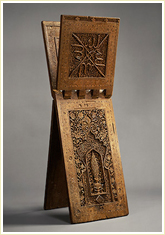
Qur'an stand,
1360 a.d.
Probably Iran or perhaps Central Asia
Wood, carved and inlaid |
After entering Iran in 1380, Timur (Tamerlane, r. 1370–1405), the Turco-Mongolian ruler established in Central Asia, soon controls most of West Asia. Though his vast empire is short-lived, Timur’s descendants continue to rule over Iran and Transoxiana and become leading patrons of Islamic art. |
ca. 1360–1406

Elements from a necklace
probably 14th century,
Iran, Gold sheet, chased and inset with turquoise,
gray chalcedony, glass; large medallion |
Under the Jalayirid dynasty (1340–1411), a Mongol family that establishes its rule over Iraq and northwestern Iran during the collapse of Ilkhanid power, art and architecture continue to follow the style set by their predecessor. The art of book illustration remains prominent during this period. |
1389–1405 |
Timur (Tamerlane, r. 1370–1405), the Turco-Mongolian ruler established in Central Asia, controls most of West Asia. By bringing together craftsmen from different subjugated lands, Timur initiates one of the most brilliant and influential periods in Islamic art. Timur's vast empire is relatively short-lived but his descendants continue to rule over Transoxiana as leading patrons of Islamic art. |
1400–1501

Bowl
second half of 15th century: Timurid
Northwestern Iran, Composite body,
underglaze painted and incised |
The Timurids are celebrated for their patronage, especially of architecture and the arts of the book. The style set by the Timurids is emulated from Anatolia to India, creating an "international" style. Timurid rule is based first in Samarqand and later in Herat. In Iran, Timurid governors of the Fars region are active patrons. Two leading figures are Iskandar Sultan (r. 1395–99 and 1409–14) and Ibrahim Sultan (r. 1414–35), both particularly interested in manuscript painting. The latter is himself recognized as a calligrapher. During this period, an identifiable style of painting develops in Shiraz. |
1406–1469 |
The Qara Quyunlu dynasty (Turk. "Black Sheep"; 1351–1469) expands into northwestern Iran, establishing Tabriz as its capital (1406). With the death of the Timurid ruler Shahrukh in 1447, the Qara Quyunlu extend their dominion to Fars (Shiraz) and Kirman in southern and eastern Iran. The rulers of the dynasty, especially Jahanshah (r. 1439–67), the most famous Qara Quyunlu ruler, are known for their patronage of architecture and arts of the book. Architectural commissions from Jahanshah's reign include the Darb-i Imam in Isfahan (1453–4) as well as the Blue Mosque in Tabriz (1465, originally part of a larger complex), both noted for their tile decoration. |
1469–1508

A Princely Couple with Attendants
second quarter of 15th century: Timurid
Iran or Central Asia |
After bringing Qara Quyunlu rule to an end, the Aq Quyunlu dynasty (Turk. "White Sheep"; 1396–1508) takes control of Iraq and northern Iran. Establishing diplomatic relations with Venice, the Aq Quyunlu become an international power. The rulers are recognized for their patronage of architecture, metalwork, and arts of the book. Few buildings remain from this period, however; known architectural commissions include the Nasriyya complex in Tabriz begun by Uzun Hasan (r. 1453–78) and enlarged by his son Yacqub (r. 1478–90), as well as Yacqub's palace (cited in a Venetian account from 1507). |
1501 |
Ismacil Safavi and his supporters, known as Qizilbash, or "red heads," on account of their distinctive red caps, wrest control of Azerbaijan from the Aq Quyunlu, and in the same year Ismacil is crowned in Tabriz as the first Safavid shah (r. 1501–24). Upon his accession, Shici Islam becomes the official religion of the new Safavid state, which as yet consists only of Azerbaijan. Within ten years, however, all of Iran is united under the rule of the Safavid dynasty. Though Shah Ismacil is known to have built throughout the empire, only modest buildings survive from his reign. |
1514

Shah Isma'il I (Center right) leading his Qizilbash cavalry in
battle against Uzbeg Khan Mohammad Shaybani in 1510.
Chehel Sotoun Palace, Isfahan. |
The Ottoman army wins a decisive victory over the forces of Shah Ismacil at a battle in eastern Anatolia. The Ottomans temporarily occupy the Safavid capital at Tabriz, and in subsequent years make frequent incursions into Azerbaijan, forcing the Safavids to move their capital farther east, to the less vulnerable city of Qazvin (1555). The sixteenth century is a period of frequent Ottoman-Safavid warfare, but eventually the Ottomans are expelled from Iran and Transcaucasia. |
1524–1576

Allegory of Worldly and Otherworldly Drunkenness:
Page from theDivan of Hafiz (Collected Poems of Hafiz)
ca. 1526–27
Tabriz, Iran |
Under Ismacil's son Tahmasp, the arts of the book are central in royal patronage. The shah, who had trained with masters of the painting tradition at an early age, is involved in the production of extensively illustrated manuscripts. Artists from the Qara Quyunlu, Aq Quyunlu, and Timurid court studios are brought together to form a new Safavid style of painting. In architecture, important extant buildings from Tahmasp's rule include the cAli Qapu ("Lofty Gate") and the pavilion known as Chihil Sutun ("Forty Columns"), both in Qazvin. Significant shrines are repaired and enlarged; a large octagonal domed hall known as the Jannat Saray is added to the dynastic shrine at Ardabil (ca. 1540) and a caravanserai to the tomb of the Eighth Shi ci Imam in Mashhad. |
1587–1629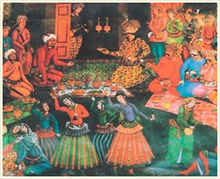
Shah Abbas I entertaining Vali Muhammad Khan of Bukhara.
Ceiling fresco at Chehel Sotoun Palace, Isfahan
|
The reign of Shah cAbbas, the most distinguished of Safavid rulers and greatest patron of the arts, is recognized as a period of military and political reform as well as of cultural florescence. The reorganization of the state and the ultimate elimination of Qizilbash power, a group that continued to threaten the authority of the throne, bring stability to the empire. In his systematization of administration, cAbbas establishes royal workshops for textiles and carpets in different cities across Iran. As Iran is actively involved in international trade, caravanserais and bridges are built throughout the empire in order to improve communication and trade. Major shrines are restored. The art of painting continues to flourish during this period; however, instead of the manuscript format, single-page paintings and drawings become popular. |
1597–98
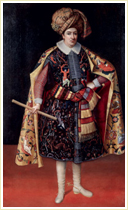
Sir Robert Shirley, Envoy from Shah 'Abbas
of Persia to the Courts of Europe
before 1628 |
Shah cAbbas transfers his capital to Isfahan, in southern Iran, where he builds a new city alongside the old one. The new capital becomes cAbbas' greatest architectural project. The centerpiece of his capital is the Maidan-i Shah (the Royal Square), with the magnificent Masjid-i Shah (Royal Mosque) as the focal point of the entire complex. Most significant architectural developments in Isfahan take place in the early seventeenth century. |
1587–1629

The Assembly of the Birds:
Page from a manuscript of the Mantiq al-tair of
Farid al-Din cAttar
ca. 1600; Safavid |
During the reign of Shah cAbbas, the encroaching armies of the Ottomans, Uzbeks, and Mughals are pushed back and the newly reorganized Safavid troops regain Tabriz, Herat, and Baghdad. cAbbas' decision to place textile and carpet production and the silk trade under state control, as well as to refurbish trade routes, solidifies the Iranian economy and attracts foreign traders. Their numerous travel accounts enliven our knowledge of daily life in seventeenth-century Iran. These Europeans also bring prints and oil paintings to Iran that have a profound effect on the local art scene, as on the arts of India and Turkey during this period. |
1617 |
Don García de Silva y Figueroa, ambassador of Philip III of Spain, arrives in Isfahan. |
1622 |
Using the ships of the British East India Company, cAbbas ousts the Portuguese from Hormuz to regain control of trade through the Persian Gulf. The English send a diplomatic embassy to Shah cAbbas, headed by Sir Dodmore Cotton. |
1637

Rustam Caried by the Div Akvan:
Folio 158 verso of the Shahnama (Book of Kings)
mid-17th century
Safavid, Isfahan, Iran |
Shah Safi (r. 1629–42) loses Baghdad and Qandahar. A product of an upbringing in the harem, Safi is a weak ruler, but his chief minister capably governs for him, keeping the country stable for the next few years. |
1642–66
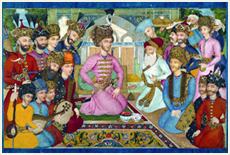
A 17th-century watercolour and gold painting of Shah Abbas II and the Mughal ambassador at court from the London exhibition Spirit & Life: Masterpieces of Islamic Art.
(The Aga Khan Trust For Culture) |
Shah cAbbas II is a better administrator than his father Safi, but is highly susceptible to the influence of religious leaders. Under him and his successors Sulayman (r. 1666–94) and Sultan Husayn (r. 1694–1722), Jews, Christians, and nonconformist Muslims all face persecution. Mismanagement, corruption, and injustice lead to the steady decline of the Safavid empire. |
| |
|
|
|
|
|
|
|
 |
|
 |
|